
REVIEW · BARCELONA
Barcelona: City Highlights Segway Tour
Barcelona is a big city with sights spread across several neighborhoods, and this three-hour Segway tour covers a surprising amount of ground. You move from the Gothic Quarter and Port Vell to Ciutadella Park, Sagrada Familia, the Olympic Port, and Barceloneta without spending the day on foot.
I like the street-level view, which feels more personal than a bus, and I like the guides’ flexibility. Pablo used photos and drawings to explain Barcelona, while Miguel adjusted the pace for an older couple in the June heat. The main drawback is simple: three hours on a Segway can feel long, especially in hot weather, and the tour does not include entry to Sagrada Familia or any other attraction.
Key points to know before booking
- Sagrada Familia is a photo and explanation stop, not an interior visit: You see Gaudí’s basilica from outside and learn about its sculptures and symbols.
- The route covers old city, park, and beach: Expect Gothic streets, Port Vell, Ciutadella Park, Eixample, Barceloneta, and the Olympic waterfront.
- Training is included: You get a safety briefing and practice session before setting off from Jardins de les Tres Xemeneies.
- The group can be split into units of six or fewer: Bookings can reach 30 people, but larger groups are divided among guides.
- You must meet specific riding requirements: Segway riders must be at least 14 years old, 150 centimeters tall, and between 45 and 130 kilograms.
- The price is fair for a city overview: At $48 per person, you are paying for three hours of transport, guiding, equipment, and broad coverage, but not attraction admissions.
Why a Segway works well in Barcelona
Barcelona rewards a tour that can move between districts. The Gothic Quarter is compact and winding, while the beach, Sagrada Familia, Ciutadella Park, and Port Vell are spread across the city. A walking tour handles one or two of these areas well. A bus gives you distance but less contact with the streets.
A Segway sits between those options. You are exposed to the city, with no bus window or roof between you and the buildings, but you can cover more ground than you could on foot. That matters on a first visit when you want to understand how the old center, planned Eixample, parks, and waterfront fit together.
The tour starts with a training session in the middle of the street-art and skate area at Jardins de les Tres Xemeneies. You do not look for a shop. Your guide and Segway are waiting at Passatge de la Canadenca, 6, about five minutes before your booked time. The nearest metro stops are Paral-lel on lines L2 and L3, using the Nou de La Rambla exit.
The practice session is not just a formality. The tour operator says the guide gives full instructions on safe operation, and one participant in his sixties found the machine comfortable after about 15 minutes of coaching. You still need to pay attention. Turning, stopping, and sharing paths with pedestrians require calm control.
More Segway City Tours in Barcelona
- Barcelona: City Highlights Guided Segway Tour
★ 4.9 · 624 reviews - Barcelona: 3-Hour Segway Sightseeing Tour
★ 4.8 · 101 reviews - Sightseeing Segway Tour in Barcelona
★ 5.0 · 60 reviews
From Las Ramblas to Barcelona’s medieval core
The early part of the route takes you toward Las Ramblas and the Gothic Quarter. The route then winds through the old center, where narrow streets and medieval churches create a sharp change from Barcelona’s broad modern avenues.
You pass the Basilica of Our Lady of Mercy, known as Basilica de la Mercè, dedicated to Barcelona’s patron. The stop is brief, so I would treat it as an orientation point rather than a full church visit. You get context from the guide and a chance for photographs, but admission is not part of the tour.
The Basilica of Santa Maria del Mar and the Born district give you another look at old Barcelona. Santa Maria del Mar is one of the city’s important medieval churches, while El Born Centre Cultural sits in a former market building and preserves archaeological remains below its modern structure. The tour stops outside these places, giving you useful pointers for a later visit.
This section is one reason the Segway format can be fun, but it also requires care. Narrow streets are better for seeing details than for speed. Your guide has to balance movement with pedestrians, uneven surfaces, and the needs of the whole group. Do not expect to glide through every lane at full pace.
Port Vell, Columbus, and the city facing the water
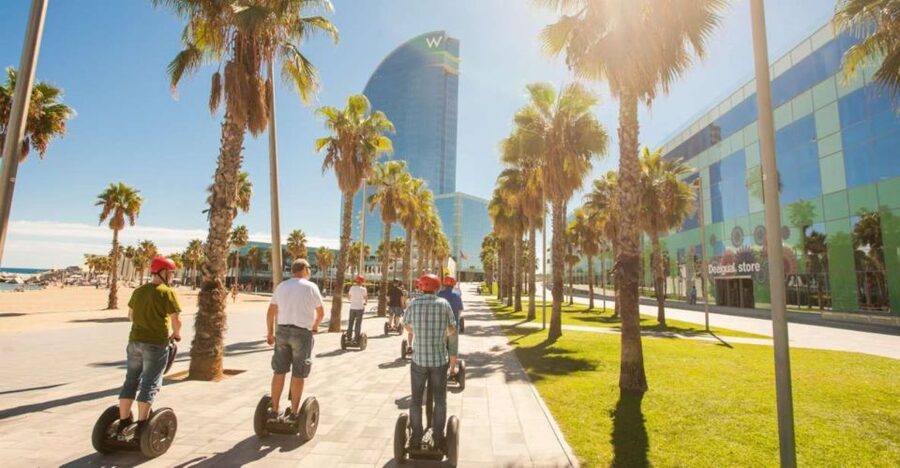
From the old center, the route reaches Port Vell and Moll de la Fusta. This is Barcelona’s waterfront promenade, with open views and more room to move than in the Gothic Quarter.
You stop at the Maritime Museum of Barcelona and the Columbus Monument. These are short photo and explanation stops, each listed at about five minutes. The Columbus statue is an easy marker at the end of Las Ramblas and a useful place to understand the relationship between the old city and the harbor.
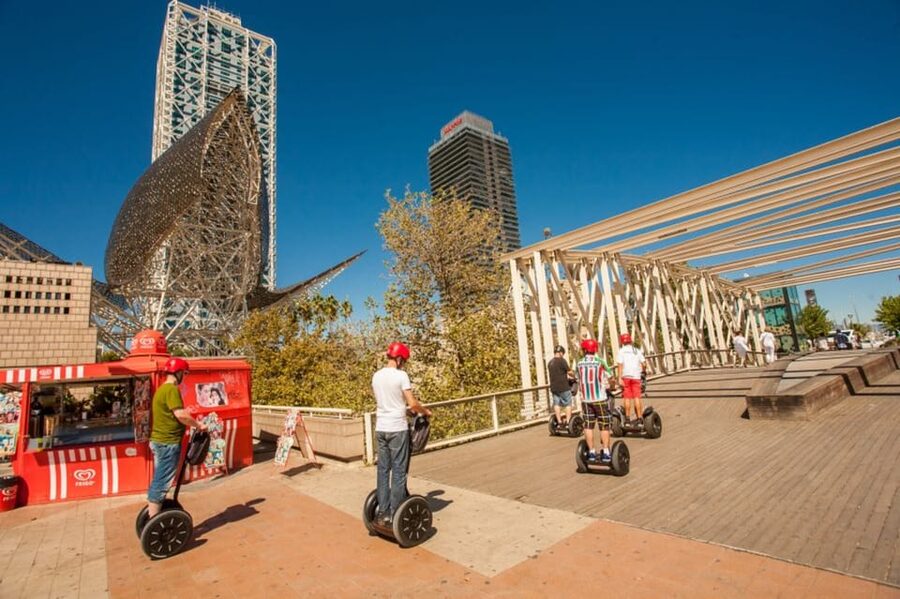
You also pass El Cap de Barcelona, a large public sculpture near the waterfront. It is not a major sightseeing stop in itself, but it adds a bit of modern public art to a route otherwise filled with churches, monuments, and historic streets.
The waterfront section helps explain Barcelona’s change over time. The city once turned its back on parts of the port and industrial shoreline. Later projects made the sea more accessible, with the 1992 Olympic Games playing a major role in reshaping the coast. The guide uses the ride to connect the harbor, beaches, and Olympic Port rather than presenting them as isolated photo stops.
Ciutadella Park and the Arc de Triomf

The route then heads inland to Parc de la Ciutadella, one of the city’s best places for open space. The park includes a large lake, many plant species, and the Parliament of Catalonia. Its design was influenced by the Luxembourg Garden in Paris, and the site began as a military fortress before becoming a public park.
I like this change of pace. After the tight Gothic streets and busy waterfront, the park gives you room to breathe and a chance to stop in the shade. One guide made a point of taking shaded routes and scheduling breaks during a hot June morning, which is exactly the kind of practical judgment that matters on a three-hour ride.
Nearby, the Arc de Triomf marks the entrance to the 1888 Universal Exhibition of Barcelona. Unlike many triumphal arches, this one was built as a welcoming gateway rather than a military victory monument. You can see it without entering an attraction, and the broad avenue around it makes a good place for the guide to explain Barcelona’s growth.
The tour also passes La Monumental, the former bullring in the Eixample. Its decorative brick and tile exterior reflects the city’s architectural mix. Again, the stop is about seeing and understanding the building from outside, not going in.
More Segway City Tours in Spain
- Barcelona Top Highlights Segway Tour
★ 5.0 · 58 reviews - Montjuic Panoramic Segway/e-Bike Tour
★ 5.0 · 48 reviews - Highlights of Barcelona Segway Tour
★ 5.0 · 41 reviews - Barcelona: Gaudí Sightseeing Guided Segway Tour
★ 4.8 · 32 reviews
The Eixample and the Sagrada Familia stop
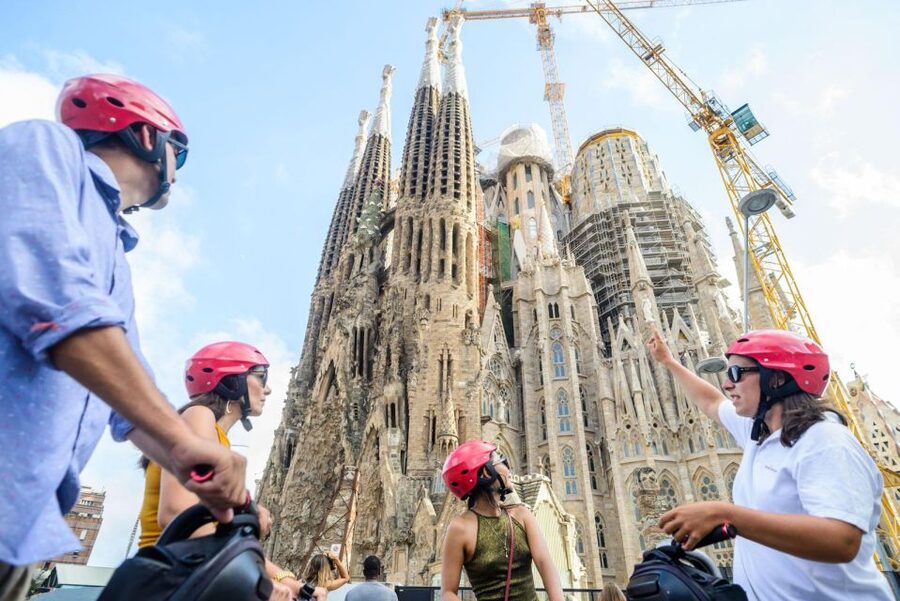
The Eixample is Barcelona’s large grid-planned district, created as the city expanded beyond its old walls. Its broad avenues make this part of the trip easier for a Segway group, and the change from medieval lanes to regular blocks is one of the clearest ways to read Barcelona’s urban development.
The main stop here is Sagrada Familia. You get around 15 minutes for photographs and a guided explanation of Gaudí’s basilica. The guide points out the different sculptures and the messages built into the facades, giving you details to look for rather than leaving you with a quick exterior snapshot.
This is important: the tour does not include entry inside Sagrada Familia. If you want to see the interior, you need to arrange a separate ticket and return on your own. The Segway stop works best as a first introduction. You can learn the basic story, see the exterior details, and decide if you want to give the basilica more time later.
Because the stop is short, do not expect a full architectural lesson. The value comes from the wider route. You see Gaudí’s most famous work as one part of Barcelona’s development, alongside medieval churches, a planned district, public parks, and the rebuilt coast.
Olympic Port, Barceloneta, and the beach
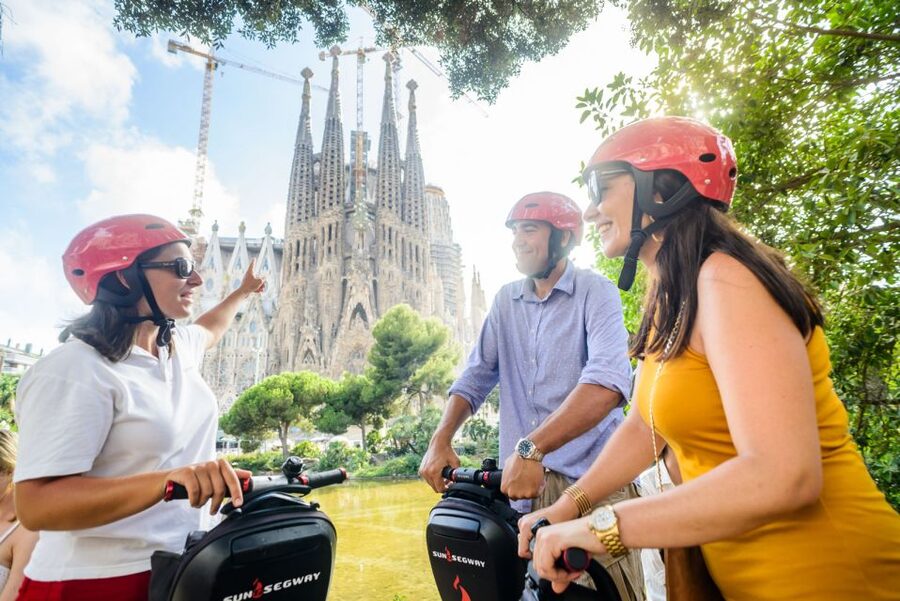
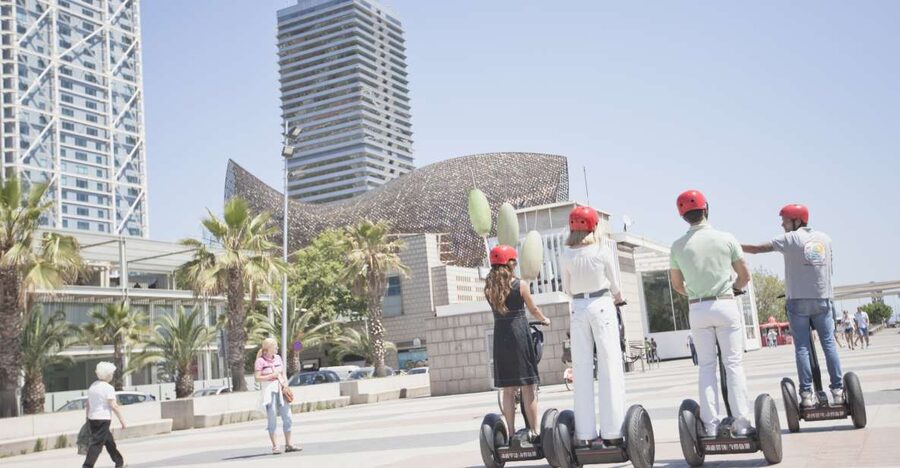
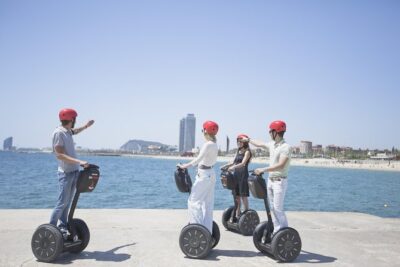
The final major section takes you back toward the Mediterranean. You pass Olympic Port and La Barceloneta, the old fishermen’s neighborhood, before continuing along the seafront.
Barceloneta gives the tour a more local urban texture than the grand monuments. Its streets are compact, and the district connects the historic center with the public beaches. The guide explains how the relationship between Barcelona and the sea changed, especially after the 1992 Olympics.
This is another section where weather matters. On a warm day, you get sun, open pavement, and limited shade. One couple found the three-hour route demanding in June heat and needed a bakery stop, fresh orange juice, water, and a bathroom break. The guide was responsive, but you should still bring water and plan for the conditions.
From the shore, the route returns past the Baluard de Migdia and the old sea walls before reaching the Columbus Monument and Maritime Museum area again. The final stop at Parc del Mirador del Poble-sec offers a higher viewpoint and a last look across the city before you return to Passatge de la Canadenca.
Guides, languages, and group size
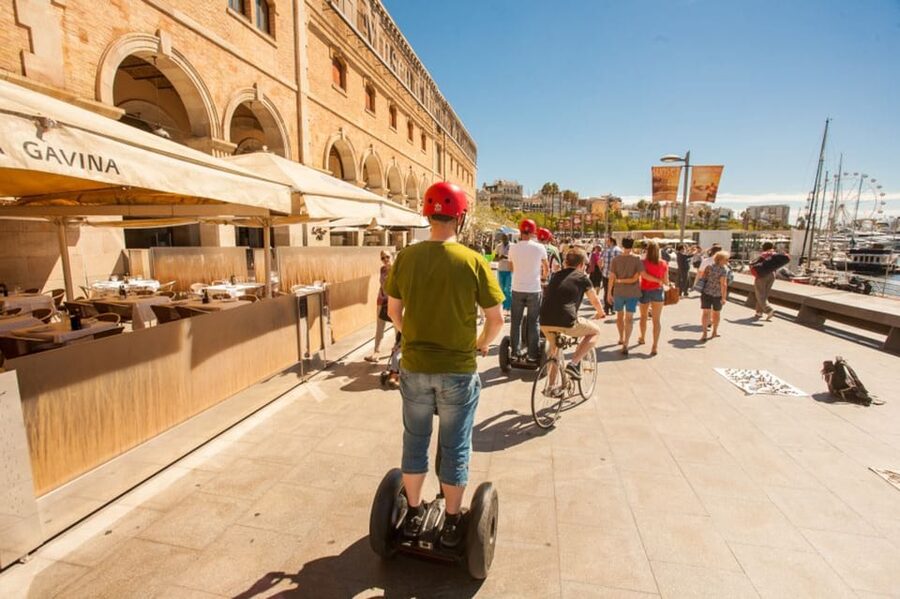
The tour offers live guiding in Spanish, English, French, Italian, Arabic, and Portuguese. Named guides connected with the experience include Max, Pablo, Miguel, and Nico. Max is especially useful if you need English or French, while Pablo has used printed illustrations and photographs to add context during the ride.
The exact feel of the tour depends on the guide and group. A full booking can include up to 30 people, but larger groups are split into smaller units of six or fewer, each with a professional guide. That is a much better arrangement than trying to move 30 Segways as one mass.
Small private groups are also available. If you care about adjusting the pace, asking many questions, or tailoring the route, a private booking may be worth considering. A small group can also make the short photo stops more useful.
The strongest part of the guiding is not just naming buildings. It is the way a good guide links them. Pablo’s use of visual material helped turn passing facades into stories, while Miguel paid attention to shade, breaks, and an older couple’s comfort. Those details can make the difference between a pleasant ride and a tiring one.
What the $48 price really buys you
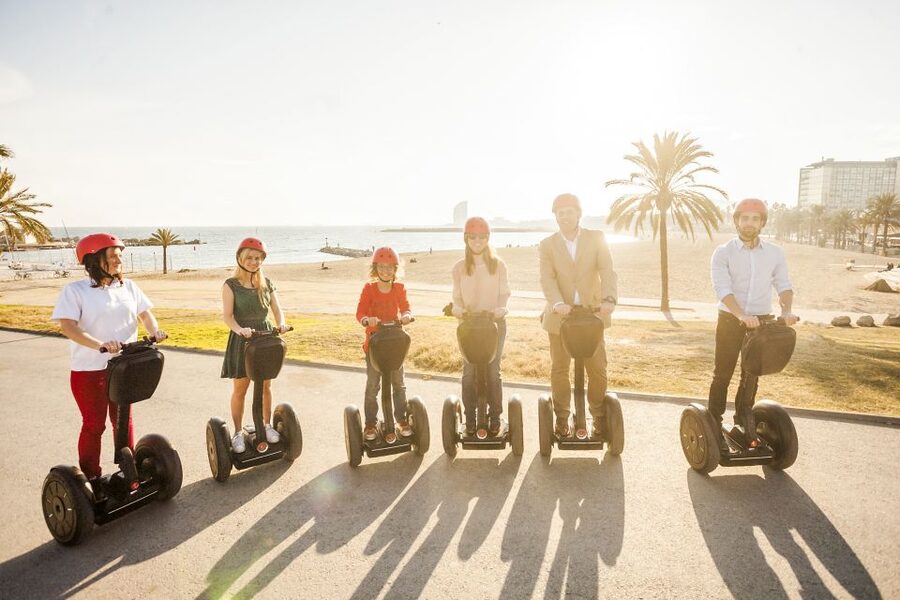
At $48 per person, the tour is reasonably priced for a three-hour city overview. The fee includes the Segway, helmet, training, and live guide. You are also paying for a route that connects sights spread across several parts of Barcelona.
The value is strongest if this is your first or second day in the city. You can learn where the Gothic Quarter sits relative to the port, how Ciutadella Park connects with the Arc de Triomf, and how far Sagrada Familia is from the beach. That basic map in your head can make the rest of your visit easier.
The price is less attractive if you mainly want deep visits inside monuments. No attraction admission, food, drinks, hotel pickup, or drop-off is included. You will need separate time and tickets for Sagrada Familia, the Maritime Museum, Santa Maria del Mar, and any other interior you want to explore.
I would compare it with the cost of a private guide, taxi rides between districts, and the time saved over walking. For two or three hours of coverage, $48 is fair. For a family whose younger children cannot ride Segways, the value changes because children under 14 use e-bikes instead.
Who should book this ride
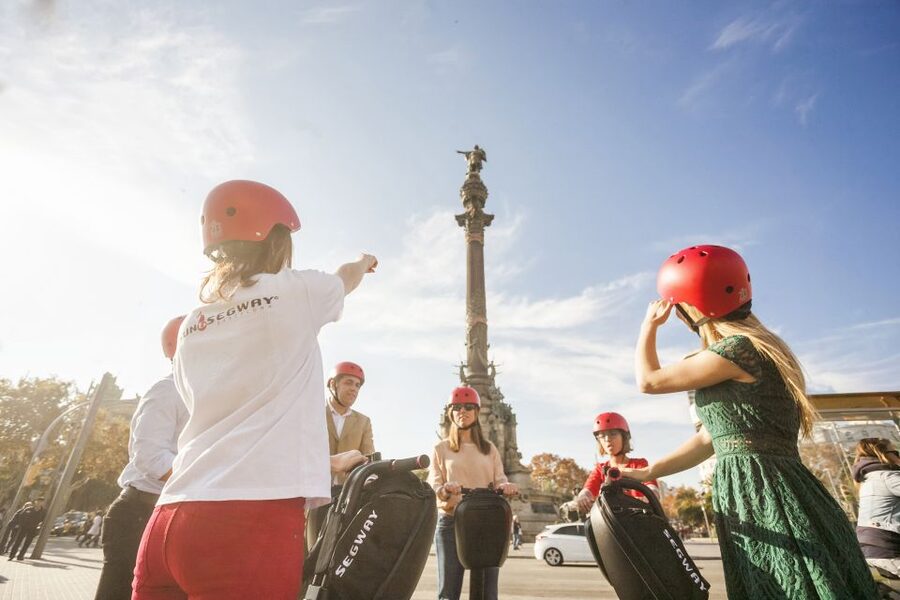
I would choose this tour if you want a broad first look at Barcelona and feel comfortable learning a new vehicle. It suits couples, friends, and families with teenagers who meet the age and size requirements. It also suits older riders who can manage the machine and appreciate a guide who controls the pace.
You need to be at least 14 years old, at least 150 centimeters tall, and between 45 and 130 kilograms to ride a Segway. Pregnant women and people with back problems should not join. Bring comfortable shoes, sunglasses, weather-appropriate clothing, and a passport or ID card.
For summer, I would book an early start if available, carry water, and avoid assuming that three hours will feel effortless. In winter, wear warm, water-resistant clothing and gloves. Comfortable shoes matter because you may spend time standing during explanations and stops.
The tour is not suitable if you dislike open-air city riding, need a slow walking pace, or want long visits inside historic buildings. It is also not the best single choice for someone whose top priority is only Sagrada Familia. In that case, book a dedicated basilica visit and use this ride for the wider city.
Should you book the Barcelona City Highlights Segway Tour?
Book it if you want to cover old Barcelona, the port, parks, Eixample, Sagrada Familia, and the beaches in one outing. The route is broad, the price is reasonable, and the best guides add real local context rather than simply pointing at buildings.
I would be more cautious in very hot weather or if three hours of standing and riding sounds tiring. Go prepared with water, wear sensible clothes, and remember that this is an overview, not a series of full museum visits. For a first taste of Barcelona at street level, it is a practical and enjoyable choice.
FAQ
Where does the Barcelona Segway tour start?
The meeting point is Passatge de la Canadenca, 6, inside Jardins de les Tres Xemeneies. Your guide and Segways wait in the training square within the street-art and skate park area, not at a store.
How do I reach the meeting point by metro?
Take the purple L2 or green L3 line to Paral-lel station and use the Nou de La Rambla exit.
How long does the tour last?
The tour lasts three hours, including the training and sightseeing route.
Is Sagrada Familia included inside the tour?
No. The tour stops outside Sagrada Familia for photographs and a guided explanation. Entry to the basilica is not included.
What languages are available?
The live tour is available in Spanish, English, French, Italian, Arabic, and Portuguese.
What is the minimum age for riding a Segway?
You must be at least 14 years old to ride a Segway. Participants younger than 14 join the tour on e-bikes.
Are there weight and height requirements?
Segway riders must weigh between 45 and 130 kilograms and be at least 150 centimeters tall.
Can I cancel the booking?
You can cancel up to 24 hours in advance for a full refund. The reserve-now, pay-later option is also available.
Just added around Barcelona
- Welcome to Barcelona Segway and eScooter Tour★ 5.0 · 2 reviews
- Highlights of Barcelona Segway Tour★ 5.0 · 41 reviews
- Seaside Segway Tour in Barcelona★ 5.0 · 33 reviews
- Segway Flexible Private Tour in Barcelona★ 5.0 · 16 reviews
- Montjuic Hill: Panoramic Segway Tour★ 5.0 · 2 reviews
- Segway Tour to Sagrada Familia views★ 5.0 · 5 reviews
- Sagrada Familia Segway Tour★ 5.0 · 12 reviews
- Sagrada Familia – 2H Segway Tour★ 5.0 · 9 reviews
Barcelona Segway Tours, compared.
Barcelona: 2-Hour City Sights Guided Segway Tour
Read our review →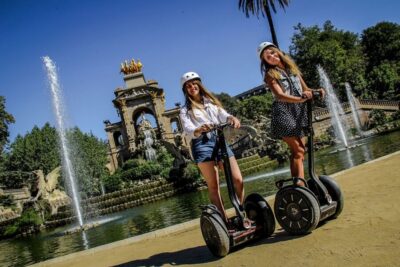

Barcelona: City and Seafront Guided Segway Tour
Read our review →
Browse the lists this tour appears in