
REVIEW · USA
History & Culture Tour in Honolulu via Segway
Honolulu’s past comes into focus quickly on this small-group Segway tour, which covers royal landmarks, missionary buildings, Chinatown, the harbor, and the oceanfront in about two and a half hours. You move far more quickly than on foot, yet still have time to stop for stories and photos.
I like the two-way radio headset, since you can hear the guide while riding in single file. I also like the tight group limit of eight, which gives guides such as Jeanne, Michael, Zach, and Allen room to answer questions and adjust the pace. The main consideration is price: at $254.14 per person, this is a costly way to see Honolulu, even with the extra ground covered.
Key points at a glance
- Mission-era Honolulu: Begin at the 1820 Mission Houses, Kawaiahao Church, and the royal cemetery.
- Royal landmarks: Glide around Iolani Palace, the Royal Barracks, and statues honoring King Kamehameha and Queen Liliuokalani.
- City layers: Pass the State Capitol, Hotel Street, Chinatown, Merchant Street, and Bishop Street.
- Harbor history: Visit Aloha Tower, once Hawaii’s tallest building, and see the restored coral reef nearby.
- Oceanfront finish: Ride through Kakaako Waterfront Park and Ala Moana Regional Beach Park.
- Practical setup: Meet at 9 a.m. in Kakaako, use a provided helmet and headset, and return to the same point.
A fast route through Honolulu’s layered past
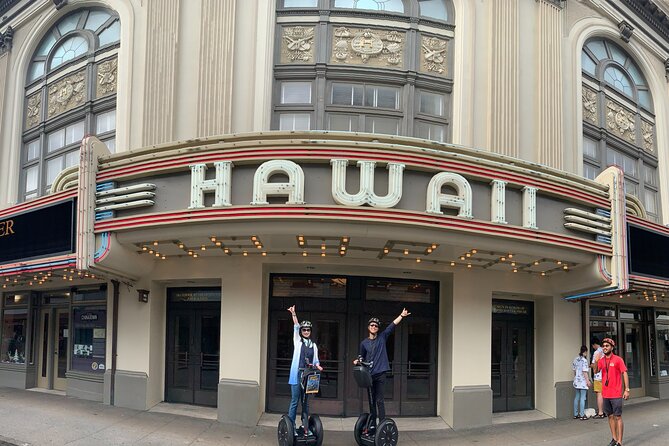
This experience is best understood as a moving history lesson with wheels. Instead of spending the morning on one compact downtown block, you connect several parts of Honolulu: the old royal center, the business district, Chinatown, the harbor, and the newer waterfront.
The route focuses heavily on the 19th century and on the political changes that shaped Hawaii. You will hear about the monarchy, the arrival of missionaries, the overthrow of Queen Liliuokalani, and the city’s growth as a port and commercial center. That gives the ride more substance than a simple sightseeing loop.
The Segway matters because Honolulu’s historic core and waterfront are spread out. You can cover more ground with less walking, then pause at important places. It is a good match for you if you want context but do not want to spend the entire morning on foot.
The experience begins and ends at Segway of Hawaii in Kakaako, at 1687 Kalauokalani Way. The advertised start time is 9 a.m., and the full outing lasts about two hours and thirty minutes. Waikiki transportation is available from four pickup locations for an additional $20 per person round trip, but you need to contact the operator to arrange it.
More Old Town Segway Tours in the USA
- 60-Minute Guided Segway History Tour of Savannah
★ 5.0 · 1,163 reviews - 90 Minute Historic Uptown Neighborhood Segway Tour of Charlotte
★ 5.0 · 917 reviews - 2 Hour Scottsdale Segway Tours – Ultimate Old Town Exploration
★ 5.0 · 433 reviews
Mission Houses and the first church
The first stop brings you to the Mission Houses, built in 1820 by Hawaii’s first missionaries. The buildings are austere, and that is part of their value. They help you picture Honolulu before the grand civic buildings, modern roads, and hotels that define much of the city today.
Next door, Kawaiahao Church dates from the same year. The church and its graveyard connect missionary-era Honolulu with the Hawaiian monarchy, since many former ali‘i, or members of the Hawaiian royal class, are buried there.
Across King Street, you can also see Honolulu Hale, the city hall. This opening section gives you several layers in a small area: traditional Hawaiian leadership, Protestant missionary influence, and the later civic structure of Honolulu.
I appreciate beginning here because the guide can explain change before you see the symbols of the monarchy and government later in the ride. You are not just collecting buildings. You are seeing how different forces shared the same center of town.
The stop is also a reminder that this tour is primarily about interpretation from outside. The supplied information does not say that interior visits to the Mission Houses or Kawaiahao Church are included, so plan on viewing these places as part of the outdoor route rather than expecting a museum visit.
King Kamehameha and Hawaii’s royal center
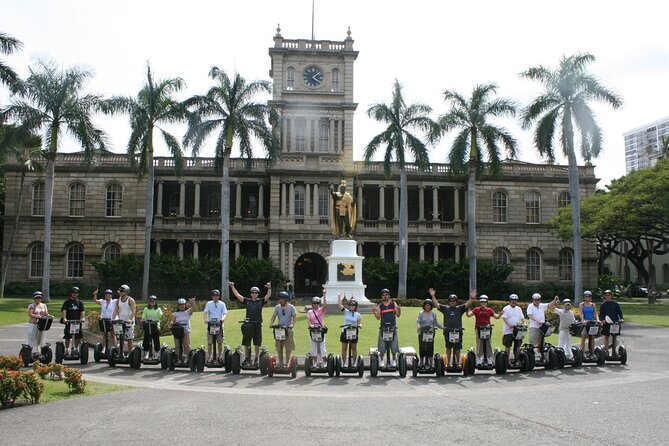
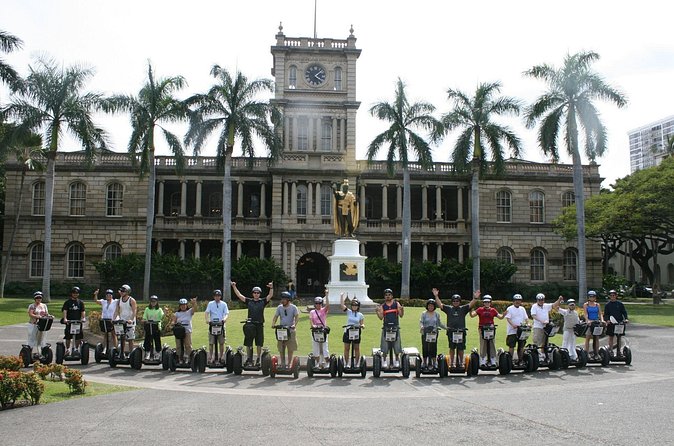
The ride continues to the gold-covered statue of King Kamehameha. One of three such statues around the world, it sits in front of the Hawaii State Supreme Court building.
That court building once served as the seat of Hawaii’s government when the islands were an independent nation. This is one of the most useful stops for understanding that Hawaii was not simply another American territory waiting to be developed. It had its own government, monarchs, political institutions, and national story.
The statue also works well as a photo stop. Because you are riding with a guide and a small group, you can pause without the stop feeling like a mass photo line. Guides have also taken photos for participants during the tour, which is useful if you want more than quick snapshots taken from the handlebars.
The gold finish catches attention, but the guide’s explanation is what gives it meaning. I would listen closely here, especially if you want to understand how Hawaiian royal symbols remain part of Honolulu’s public spaces.
Iolani Palace and the last Hawaiian monarch
After crossing King Street, you enter the grounds of Iolani Palace and the Royal Barracks. Iolani Palace is the only palace on American soil built by a reigning monarch, King Kalakaua, and it now operates as a museum.
The route takes you around the palace grounds rather than presenting a full interior palace tour. You will see banyan trees and stop at the statue of Queen Liliuokalani, Hawaii’s last ruling monarch.
This is the emotional center of the ride. Queen Liliuokalani’s government was overthrown by Americans, and the experience places that fact directly within the setting where Hawaii’s monarchy once governed. The tour does not treat the palace as a decorative photo backdrop. It links the building to the loss of Hawaiian sovereignty and to the political history that followed.
If royal history is your main reason for booking, this section will likely matter most to you. If you want a detailed palace interior visit, you may need a separate admission and more time on another day. The Segway tour gives you the setting and the story, but it keeps moving.
The Royal Barracks and palace grounds also provide a change of pace from downtown streets. You glide among older buildings and trees, then continue toward the modern State Capitol. That contrast makes the political history easier to grasp.
Same city, a different route:
- Washington DC “See the City” Guided Sightseeing Segway Tour
★ 5.0 · 1,924 reviews - Guided Segway Tour of Downtown Nashville
★ 5.0 · 1,568 reviews - Fort Lauderdale Segway Tour
★ 5.0 · 1,017 reviews - Pittsburgh Segway Tour
★ 4.5 · 769 reviews
State Capitol and Hotel Street
Behind Iolani Palace, the route reaches the Hawaii State Capitol Building. Its architecture is distinctive, and the stop broadens the story from monarchy to the modern state government.
You then pass the Hawaii State Art Museum and head along historic Hotel Street. The tour presents Hotel Street through its colorful past, adding a more social and urban note after the formal royal buildings.
This transition is useful because Honolulu’s history is not confined to palaces and statues. Streets, businesses, government offices, and art institutions all show how the city changed over time. On a walking tour, this stretch could feel like a long transfer between major sights. On a Segway, it becomes part of the route rather than dead time.
The headset helps here. The guide can keep talking as you move, so you do not have to crowd around one person at each corner. You should still expect city riding rather than a quiet park experience. The group travels in single file, and the route links public streets with open grounds and waterfront paths.
Chinatown’s markets and many cultures
From Hotel Street, you glide into Chinatown’s shopping mall area. The route highlights noodle factories, open markets, and a population drawn from many parts of the world.
This part of the tour gives you a different view of Honolulu from the royal district. Chinatown shows the city as a place shaped by migration, food, trade, and work. It is less polished than the palace grounds, and that is precisely why it adds value.
You might find this section especially interesting if you want to see how Honolulu functions as a living city rather than a collection of historic monuments. The guide can connect the streets to the wider story of immigration and commerce, while the ride lets you see the district in a short amount of time.
Do not expect a long market visit or a food tasting. The tour passes through the area and points out its features. If you want to shop, eat, or study Chinatown in detail, save another block of time for a return visit.
Merchant Street, Bishop Street, and Honolulu Harbor
The route then moves along Merchant Street, described as Honolulu’s first paved street, before reaching Bishop Street, the city’s old financial corridor, or Honolulu’s Wall Street.
Here, the focus shifts to business and transportation. You see older commercial buildings and historic transportation structures more than 150 years old. These details help explain how Honolulu grew from a royal and port city into a modern center of trade.
This is a section where a guide adds real value. A row of old buildings can look like background scenery if you do not know what made the street important. With the headset, you can hear the explanation without stopping every few minutes.
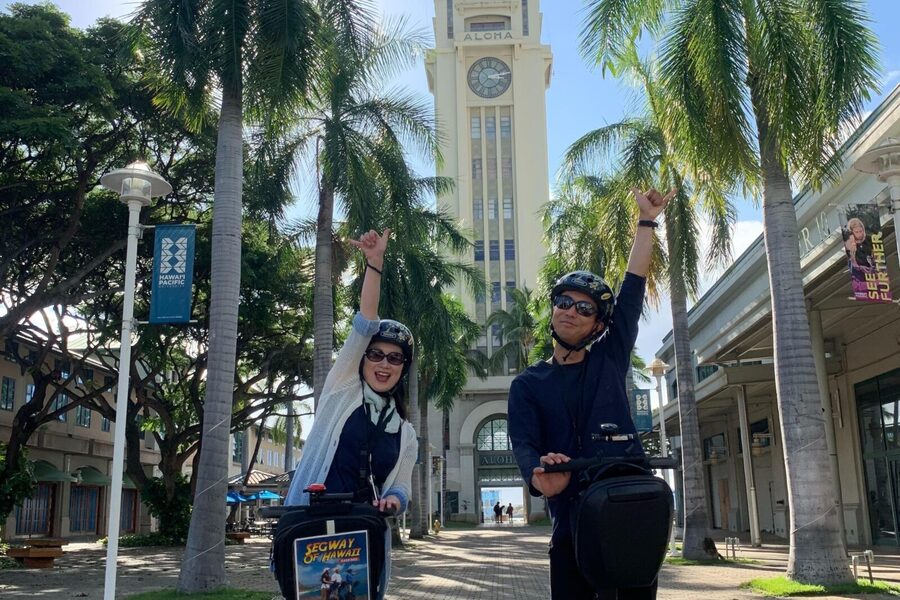
The ride continues toward Honolulu Harbor and Aloha Tower. When it was built in 1926, Aloha Tower was the tallest building in Hawaii. For decades, it served as a major welcome point for people arriving by sea, so it carries a different kind of symbolism from the palace or royal statues.
Nearby, the route includes a restored coral reef and fish that come close to feed. That gives the harbor stop a small natural-history element, even though the broader focus remains the city’s past.
The harbor can also be a practical photo stop. You get a change from civic buildings and narrow streets, with more open views and a stronger connection to Honolulu’s role as an ocean port.
Kakaako Waterfront Park and the oceanfront return
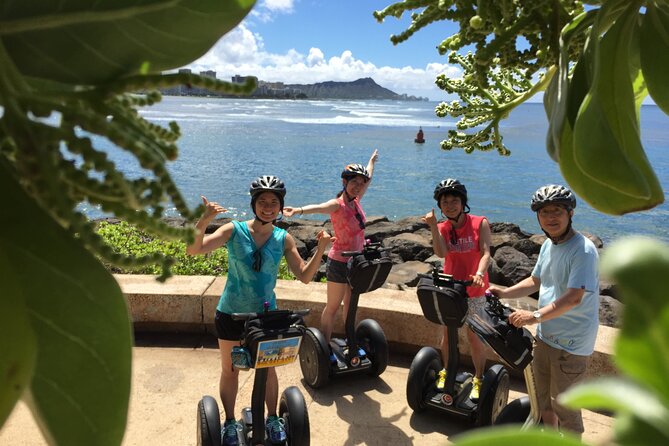
After the harbor, the ride heads toward Kakaako Waterfront Park. The park’s promenade gives you ocean views and a chance to look toward the surfers at Point Panic.
The route then climbs a hill to the Ehime Maru Memorial and the Echo Stone. The supplied details do not explain the full story of each memorial, so your guide’s account will be important here. These stops add a reflective note after the busy commercial and civic districts.
The final section returns toward the starting point along the ocean through Ala Moana Regional Beach Park. It is a fitting ending because the ride moves from Honolulu’s oldest civic center back to the coastline that shaped the city’s identity and economy.
The oceanfront portion also gives your legs and mind a break after the denser downtown stops. You are still riding, but the setting is more open. If you want scenic views as well as historical information, this closing stretch helps justify the Segway format.
What the Segway setup is like
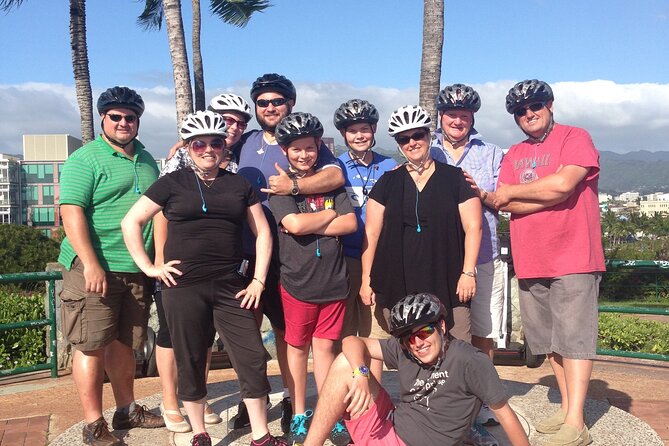
The tour includes a colorful helmet, bottled water, and a two-way radio headset. The headset is one of the most practical features because the guide can speak while the group moves, and you can hear without shouting across the street.
The group size is capped at eight people. That is small enough for personal attention, questions, and a pace that can be adjusted more easily than on a large coach tour. Guides named in the supplied material include Jeanne, Michael, Zach, and Allen. The tone of the experience appears to depend partly on who leads your departure, but the common thread is strong local storytelling and attention to first-time riders.
Several participants described this as their first Segway experience and said they learned quickly. That does not mean you should arrive without caution. You need to be comfortable following instructions, riding in single file, and staying alert around city streets. The activity information says most people can participate, but it does not provide detailed restrictions by age, weight, or mobility.
You should also remember that the tour requires good weather. If poor weather cancels the ride, you are offered another date or a full refund. Cancellation is free up to 24 hours before the start time. A late cancellation, within 24 hours, is not refundable.
Is $254.14 a fair price?
At $254.14 per person, this is not a budget sightseeing choice. You are paying for a small group, a guide, equipment, a two-and-a-half-hour route, and the ability to cover several districts without walking between them.
The value is strongest if you place a high price on saving time and hearing local context. A walking tour covering this much ground would require more effort and might leave you tired before the harbor and waterfront sections. A standard vehicle tour could cover distance, but it would not provide the same open-air ride or easy access to short stops.
The value is weaker if you mainly want to visit Iolani Palace indoors, spend time shopping in Chinatown, or linger at the harbor. This experience gives you a broad introduction, not long visits at each location. You may want to add separate museum time before or after the tour.
The Waikiki transfer costs another $20 per person round trip. That is convenient if you do not want to arrange your own way to Kakaako, but it pushes the total cost higher. Since the tour begins and ends at the same Kakaako meeting point, you should compare the transfer cost with your own transportation options.
Who should book this Honolulu ride?
I would recommend it most strongly to history-focused visitors who want a city overview in one morning. It suits you if you enjoy royal history, civic architecture, Chinatown, port history, and waterfront views in one connected route.
It is also a good fit if walking long distances is not appealing. You still need to ride and pay attention, but you avoid the footwork required to connect these districts. First-time riders can find the format approachable, based on the supplied experience notes, though you should be honest about your comfort with balance and city movement.
Families and mixed-age groups may like the small size and the variety of stops. The tour can also work well early in an Oahu visit because it gives you a useful map of central Honolulu and highlights places you may want to revisit.
I would hesitate if your main goal is a slow palace visit, a long Chinatown food stop, or a low-cost activity. The route is broad and efficient, not leisurely at every landmark. At this price, you should want both the Segway experience and the historical narration.
FAQ
Where does the tour begin and end?
The tour begins at Segway of Hawaii in Kakaako, at 1687 Kalauokalani Way, Honolulu, HI 96814. It ends back at the same meeting point.
What time does the tour start?
The scheduled start time is 9 a.m.
How long does the experience last?
The tour lasts approximately two hours and thirty minutes.
Is transportation from Waikiki available?
Yes. Round-trip transportation from four Waikiki pickup locations is available for $20 per person. You need to contact Segway of Hawaii Kakaako to arrange pickup.
How many people can join the tour?
The maximum group size is eight travelers.
What is included in the price?
The experience includes bottled water, a tour guide, a colorful helmet, and a two-way radio headset. Guide gratuity and Waikiki transportation are not included.
Should you book it?
Book this tour if you want to connect Honolulu’s royal district, Chinatown, business streets, harbor, and waterfront in one efficient morning. The small group, radio headset, and guides such as Jeanne, Michael, and Zach make the history easier to follow while you ride.
Skip it if $254.14 feels too high for a short city outing or if you want long interior visits at the palace and museums. For the right budget and interests, this is a lively way to see how Honolulu’s monarchy, immigration, commerce, and coastline fit together.
Just added around the USA
- Cave Point & Whitefish Dunes State Park Segway Tour★ 5.0 · 3 reviews
- Manitowoc Shore Segway Tour w/ Private Tour Option★ 5.0 · 2 reviews
- Sturgeon Bay Canal City Segway Tour w/ Private Tour Option★ 4.5 · 4 reviews
- Cave Point/Whitefish Dunes Segway Tour★ 4.5 · 13 reviews
- Saint Petersburg Scenic Segway Tour★ 5.0 · 39 reviews
- Savannah Bonaventure Cemetery Segway Tour★ 5.0 · 14 reviews
- Segway Tour in Historic Bonaventure Cemetery in Savannah★ 5.0 · 88 reviews
- Private Segway Experience Through La Jolla★ 5.0 · 8 reviews
USA Segway Tours, compared.

Washington DC “See the City” Guided Sightseeing Segway Tour
Read our review →
90 Minute Historic Uptown Neighborhood Segway Tour of Charlotte
Read our review →
2-Hour Guided Segway Tour of Huntington Beach State Park in Myrtle Beach
Read our review →

2 Hour Scottsdale Segway Tours – Ultimate Old Town Exploration
Read our review →Browse the lists this tour appears in